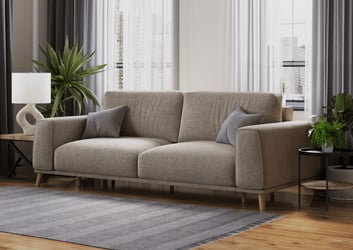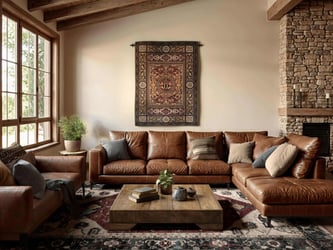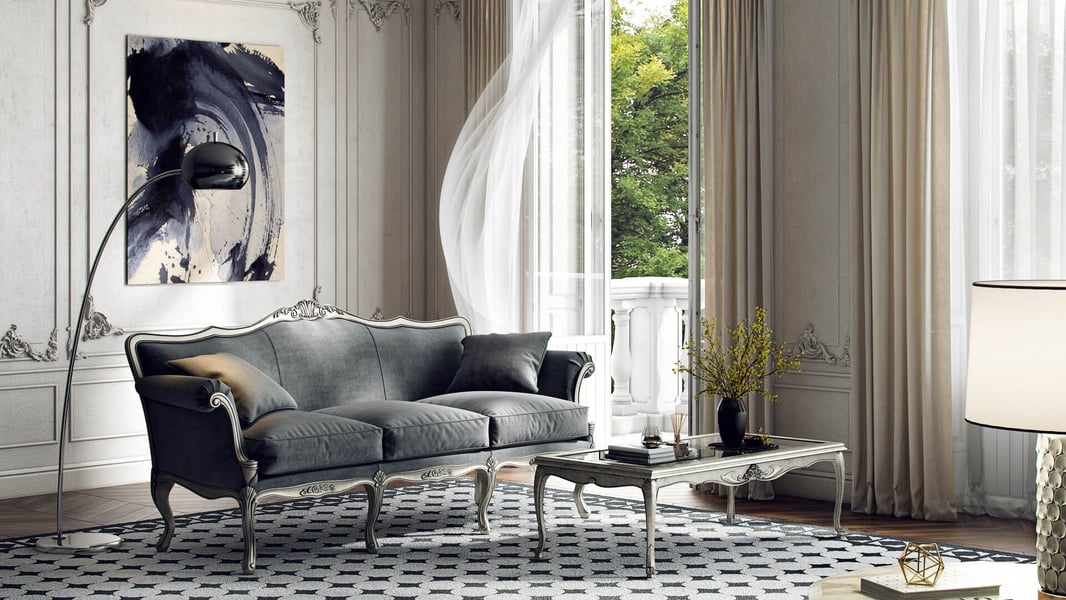
Every furniture brand reaches the same inflection point: a growing catalog, rising photography costs, and slower time-to-market than the competition demands. Traditional studio photography was once the only option for high-quality product imagery. Today, furniture 3D rendering is not only a credible alternative — for most brands, it's the smarter business decision. This guide breaks down the real cost, quality, flexibility, and business impact of both approaches so you can make an informed choice.
The Real Cost of Furniture Photography
Studio photography for furniture is expensive — and the costs add up faster than most brands anticipate. A professional studio day rate in the United States typically runs between $2,000 and $5,000, and that's before you account for the full picture. Props, stylists, set design, equipment rental, and logistics can easily double or triple the base studio fee.
For a catalog of 50 SKUs, a realistic photo shoot budget — covering studio time, stylist fees, prop sourcing, lighting setup, and post-production retouching — typically lands between $15,000 and $40,000. And that's for a single round of shooting. If a product launches in three colorways, you're either shooting three versions or asking your retoucher to do color swaps that rarely look convincing on textured upholstery.
There's also the scheduling problem. Booking a studio, coordinating shipping of physical samples, and managing shoot logistics means a lead time of two to four weeks before a single finished image exists. For brands launching seasonal collections or responding to market trends, that lag is a real competitive disadvantage.
The average US furniture photo shoot for 30 products costs $12,000–$25,000 — before retouching and logistics. Factor in reshoots for product changes, color variant re-edits, and seasonal refreshes, and the true annual cost is often two to three times the initial estimate.
Retouching is another hidden cost that compounds over time. Removing dust, correcting uneven lighting, adjusting reflections, and cleaning up fabric wrinkles from transport all require skilled post-production time. For a 30-product catalog, retouching alone can add $2,000–$6,000 to the total bill.
How Furniture 3D Rendering Changes the Economics
The fundamental economics of 3D rendering are different from photography in one key way: the upfront 3D model creation is a one-time cost that unlocks unlimited future output. Once a piece of furniture is accurately modeled in 3D — with correct dimensions, material properties, joinery detail, and finish characteristics — that model can produce any number of images from any angle, in any scene, in any colorway, without ever revisiting a studio.
Typical rendering costs range from $25 to $150 per image, depending on complexity. A simple silo render (white background, single angle) for an upholstered chair might cost $35. A fully styled lifestyle scene — the same chair placed in a living room with props, ambient lighting, and a wall art backdrop — might run $150–$250. Compare that to the $200–$500 per-image cost of equivalent photography, and the math strongly favors CGI for any catalog beyond a handful of products.
For a 50-SKU catalog, furniture brands that switch to 3D rendering typically report cost savings of 60–80% compared to traditional photography. And because the 3D model is a reusable digital asset, the per-image cost continues to fall with each subsequent use. Year two of CGI is dramatically cheaper than year two of photography.
Furniture brands switching to 3D rendering report cost savings of 60–80% compared to traditional photography — with faster turnaround. A catalog of 50 products that cost $30,000 to photograph can often be produced in 3D for $8,000–$12,000, including 3D model creation and multiple views per product.
Turnaround is another area where CGI has a structural advantage. Standard lifestyle renders deliver in three to five business days. Rush projects can often turn around in 24–48 hours. There's no studio to book, no samples to ship, and no scheduling conflicts to navigate. See our lifestyle 3D rendering services for a full overview of what's included in a typical project.
Quality Comparison: Can You Tell the Difference?
This is the question most brands ask first, and it's the right one. The honest answer in 2026 is that high-quality CGI is functionally indistinguishable from photography for the vast majority of product imagery applications. Consumer studies consistently show that most shoppers cannot reliably identify whether a furniture product image is a photograph or a render when both are executed at a professional level.
The quality ceiling of CGI is determined by two factors: the accuracy of the 3D model and the skill of the lighting and scene composition. A well-built 3D model — with accurate geometry, realistic material maps, and correct scale — rendered in a physically-based rendering engine with thoughtful lighting will produce images that hold up to scrutiny at any zoom level.
CGI actually has several quality advantages over photography that are worth naming. Lighting in a 3D scene is mathematically consistent — there are no lens flares, hotspots, or shadow inconsistencies from a real light source moving between shots. Dust doesn't settle on surfaces mid-shoot. There are no camera lens distortions to correct in post. The result is a cleaner, more controlled image that requires less retouching to achieve a polished finish.
Photography does retain a meaningful advantage in one specific area: capturing the authentic texture of complex natural materials at extremely close range. Exotic hardwoods with visible grain variation, natural stone tabletops with unique veining, and hand-woven textiles with irregular fiber patterns are genuinely difficult to replicate with 100% accuracy in CGI. For ultra-premium products where the material itself is the hero, photography may still be the right choice for certain hero shots.
Flexibility That Photography Can't Match
If cost and quality were the only factors, the decision would already be straightforward for most brands. But the flexibility advantage of 3D rendering is arguably the most transformative aspect of the switch — and it's what makes CGI indispensable for brands with expanding product lines.
Consider a sofa that launches in five fabric options. With photography, you're booking five separate shoot days, shipping five physical samples, and managing five rounds of retouching. With CGI, you build one 3D model and apply different material maps for each colorway. The additional renders cost a fraction of the original model creation, and all five versions are delivered in days rather than weeks.
The same logic applies to seasonal content refreshes. The same sofa model can be placed in a summer-lit Scandinavian living room scene in June and a warm, dark-toned winter setting in November. You're updating the scene context, not rebuilding the product. This kind of content flexibility gives brands the ability to keep product pages fresh and responsive to seasonal trends without the cost and lead time of new photography.
- Change fabric color or finish — no re-shoot required, just a material map update
- Launch a new colorway in 48 hours from approval
- Seasonal variations: same scene, different lighting mood and prop palette
- Place any product in any scene from your existing library — immediate cross-sell imagery
- Perfect for product configurators requiring multiple color and material combinations
Product configurators on DTC websites and Amazon are perhaps the most compelling use case for CGI flexibility. A dining table that comes in four wood finishes, three sizes, and two base options generates 24 possible combinations. Photographing all 24 is cost-prohibitive. Rendering them from a single 3D model is routine. Brands that want to understand how this scales operationally should read our guide on scaling a furniture brand with 3D rendering. Explore our furniture CGI portfolio to see how brands handle large variant catalogs.
When Traditional Photography Still Makes Sense
A balanced assessment requires acknowledging the cases where photography remains the stronger choice. The goal isn't to replace photography categorically — it's to deploy each medium where it delivers the best return.
Ultra-premium products where the material texture is the central selling point may still benefit from photography for their primary hero images. A dining table hewn from a single slab of live-edge walnut, with natural grain character that's unique to each piece, is genuinely difficult to represent accurately in CGI without extensive custom material work that may exceed the cost of a photography day.
Campaign and editorial photography featuring human models in real environments has a distinctly "shot" quality that CGI intentionally doesn't replicate. Lifestyle campaigns for brand awareness — the type that run in shelter magazines or as full-page ads — often benefit from the organic feel of real photography with human subjects. These are brand-building images, not product catalog images, and they serve a different purpose.
For very small product batches — one to three items with no planned variants — the time and cost of 3D model creation may not justify the investment over a simple half-day photo shoot. However, this threshold is shifting as model creation costs have fallen significantly in recent years.
Comparison: 3D Rendering vs Photography
| Factor | 3D Rendering | Photography |
|---|---|---|
| Cost per image | $25–$250 | $150–$500+ |
| Turnaround time | 2–5 business days | 2–4 weeks |
| Color/material variants | Easy — model update only | Requires new shoot session |
| Re-shoot if product changes | No — update 3D model | Yes — new studio session |
| Scene flexibility | Unlimited — any scene, any angle | Limited by physical set |
| Amazon white BG compliance | Native — trivial to produce | Requires background removal |
| Scalability | Scales linearly with lower per-unit cost | Each SKU requires logistics |
The Hybrid Approach Most Brands Use
The most commercially effective furniture brands don't think of this as a binary choice. They use CGI as the backbone of their product imagery infrastructure — handling hero product shots, lifestyle scenes, variant images, and catalog content — while selectively using photography for brand campaigns that feature human subjects or one-of-a-kind editorial content.
A typical hybrid strategy works like this: the full product catalog is produced in 3D CGI, giving the brand consistent quality, fast turnaround, and easy updates for colorways and variants. One or two times a year, a photography day is commissioned for campaign imagery — a brand lifestyle shoot with models in a real space that's used for advertising, social media, and PR. The CGI handles the commerce layer; photography handles the brand storytelling layer.
This approach typically reduces total annual imagery spend by 50–70% compared to a photography-only strategy, while improving both consistency and volume of content. Brands that commit to this hybrid model generally find that the savings in CGI production more than fund the higher-quality photography they commission for campaigns — and they end up with better imagery overall across both channels.
For brands selling on Amazon, the efficiency of CGI is even more apparent — see our breakdown of how 3D renders outperform studio photos for Amazon furniture listings. Before starting your first project, it's also worth reviewing what files you need to start a 3D rendering project so you know exactly what to prepare. If you're ready to evaluate what the switch would look like for your catalog, get a free rendering quote and we can show you a cost comparison based on your actual SKU count and delivery requirements.
Ready to Switch to 3D Rendering?
Tell us about your product catalog and we'll put together a cost comparison showing exactly what CGI would look like for your brand — with sample renders for your category.
Get a Free Quote