Amazon sells more furniture than any other channel in the United States, and the competition for visibility on category pages is relentless. With dozens of similar products appearing side by side, the quality and completeness of your product imagery is often the deciding factor in whether a shopper clicks your listing or a competitor's. 3D CGI rendering has become the leading tool for furniture brands that want to compete seriously on Amazon — and for good reason. It's faster, more cost-effective, and structurally better suited to Amazon's requirements than traditional studio photography.
Amazon's Furniture Image Requirements
Amazon's image guidelines for furniture are strict, and non-compliance results in listing suppression or reduced search visibility. The main product image must feature the item on a pure white background (RGB 255, 255, 255), with the product filling at least 85% of the frame. Minimum resolution is 1,000 pixels on the longest side, though 2,000 pixels or above is recommended to enable Amazon's zoom feature.
Secondary images can show lifestyle scenes, detail close-ups, dimension diagrams, and informational graphics. Amazon allows up to nine images per listing, and brands that use all nine slots consistently outperform those that don't. A+ content modules — available to brand-registered sellers — allow richer visual storytelling with comparison charts, large lifestyle banners, and feature callout sections.
This is where CGI has a structural advantage: a pure white background is the default output in a 3D render. There's no background removal required, no edge artifacts from imprecise masking, and no risk of failing Amazon's purity check for the main image. The exact product scale within the frame, pixel dimensions, and color profile (sRGB) are all set at the point of render — giving you precise, repeatable compliance across your entire catalog.
Amazon penalizes listings with poor imagery in search rankings. Non-compliant main images can lead to listing suppression. Compliant, high-quality images with strong secondary lifestyle content are a direct ranking and conversion factor — not a cosmetic detail.
The Conversion Power of Lifestyle Images on Amazon
The main product image gets you the click. The secondary lifestyle images close the sale. This is the core dynamic on Amazon furniture listings, and brands that understand it consistently outperform those who rely solely on white-background shots.
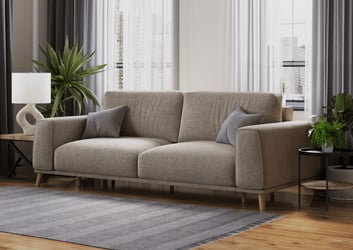
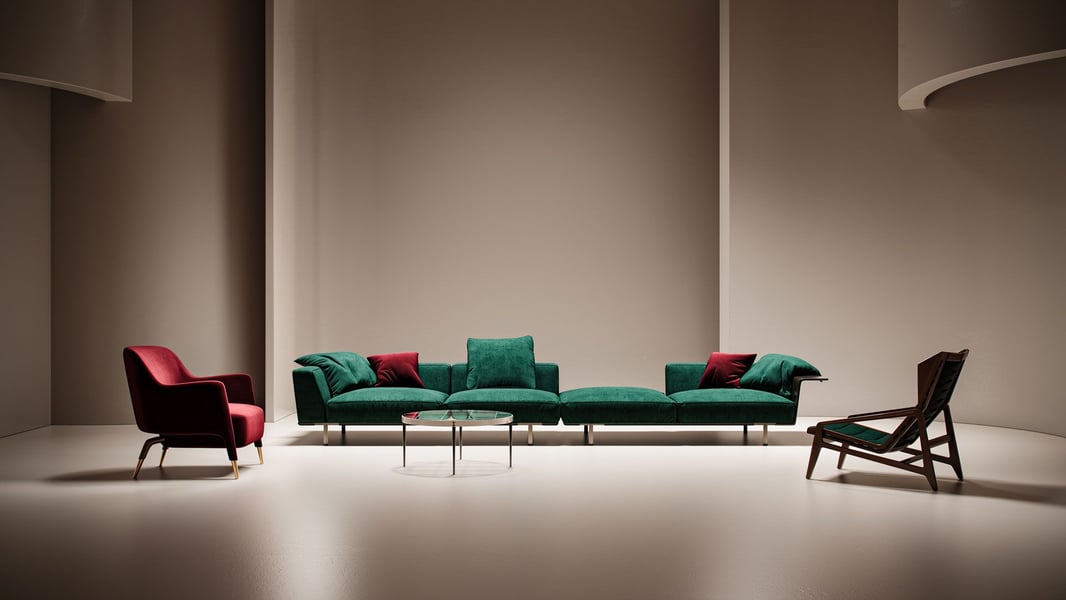
Amazon's own data, as well as third-party seller research, consistently shows that lifestyle secondary images can increase conversion rates by 30–40% compared to listings with only silo images. Shoppers want to see the sofa in a living room. They want to understand how the dining table fits in a real space, how the bed looks in a fully staged bedroom, how the coffee table relates to the surrounding furniture. A styled scene answers these questions instantly — far more effectively than product dimensions on a spec sheet.
A+ content takes this further. Brand-registered sellers can build modular content sections below the product description that include large lifestyle banners, comparison charts, feature-callout grids, and story-driven layouts. Amazon's internal data shows that A+ content can increase sales by 3–10% on average — with premium A+ content (available to vendors and top-tier sellers) performing even higher. CGI lifestyle images are the primary visual asset for all of these modules.
The lifestyle rendering service we provide is specifically designed to produce Amazon-ready secondary images — with correct aspect ratios, color profiles, and resolution for both standard listing slots and A+ content modules. We can produce multiple scene variations from a single project, giving you different room contexts to appeal to different customer segments (apartment living, family homes, home offices, etc.).
3D Rendering vs Photo Studio for Amazon Specifically
The Amazon-specific calculus for photography vs. rendering is even more favorable for CGI than the general comparison. Here's why.
Timeline is critical on Amazon. A product that isn't live isn't generating revenue. Traditional studio photography for furniture takes two to four weeks from sample shipping to final delivery of retouched images. CGI lifestyle renders for an Amazon listing — main white BG image, three to four lifestyle secondary images, and a detail shot — can be delivered in three to five business days. For product launches, that speed difference is commercially significant.
Cost is also more favorable for CGI in the Amazon context. A professional studio image of a furniture piece, fully retouched and background-removed, typically costs $150–$400 per image. An equivalent CGI silo render runs $30–$80; a lifestyle scene $150–$250. For a catalog of 50 products with four images each, the cost difference is substantial.
The re-shoot problem is uniquely painful on Amazon. If a product changes — new fabric option, updated hardware, revised dimensions — photography requires coordinating new samples and a new studio session. With CGI, the 3D model is updated and new renders are produced in days. For brands iterating on their product line, this is an enormous operational advantage.
Amazon requires consistent image quality across your full catalog. CGI makes this achievable because every image is produced in the same controlled environment, with the same lighting logic, at the same resolution. Photography struggles to maintain visual consistency across shoot days, studios, and photographers.
Amazon 360° Product Views for Furniture
Amazon's 360° interactive product viewer is available for eligible sellers and allows shoppers to rotate a product through a full spin — examining it from any horizontal angle. For furniture, where shape, proportion, and back/side details matter as much as the front view, this feature has a measurable impact on purchase confidence and return rates.
Brands with 360° views on their Amazon listings consistently report lower return rates, particularly for upholstered seating and case goods. Shoppers who have examined a product from all angles are better calibrated to what they're receiving — reducing the "it looked different online" returns that are disproportionately common in furniture eCommerce.
The beauty of CGI-based 360° production is that it uses the same 3D model already built for your static renders. Rather than photographing a product on a turntable — which requires precise lighting consistency across all frames — we render a sequence of frames directly from the 3D model. Amazon's spin viewer requires 24 or 36 frames at specific angles, which our production pipeline delivers as a standard deliverable. See our 360° view service for technical specifications and delivery format details.
A+ Content and Brand Stores with CGI
Amazon's A+ content system rewards brands that invest in visual storytelling. The difference between a standard listing and a well-executed A+ listing is visible immediately — and it's primarily a difference in image quality and variety. CGI gives brands the visual assets to build A+ content that looks genuinely premium, not assembled from whatever photography happened to be available.
Full-width lifestyle images for A+ module backgrounds benefit enormously from CGI because the aspect ratios required (often 2:1 or wider) are difficult to produce in studio without very wide set builds. In CGI, the camera angle and frame are set digitally — any aspect ratio is equally straightforward to produce.
Detail close-ups of fabric texture, joinery craftsmanship, hardware finish, and stitching are another A+ content staple. In photography, these require macro lens work and precise lighting setups. In CGI, a close-up render is a camera position change — the detail is already in the model at full fidelity.
Brand stores on Amazon — the microsite each brand can build within the Amazon ecosystem — benefit from consistent visual language across all hero images and category headers. Because CGI produces every image from the same controlled environment, brand stores built on CGI assets look coherent and intentional rather than assembled from disparate photography sessions.
Step-by-Step: Getting Amazon-Ready CGI Images
- Provide your product specifications, technical drawings, reference photos, and material/finish samples (physical or digital)
- Our 3D modelers build an accurate model with correct dimensions, material properties, and finish detail
- We produce the white-background main image to Amazon spec (2000×2000px minimum, sRGB, JPEG) plus lifestyle secondary images
- You review and approve renders — we apply revisions as needed
- Final files delivered in all required formats: Amazon listing images, A+ module dimensions, and originals for future use
The entire process from brief to final delivery typically runs three to five business days for standard products. Complex pieces with custom upholstery or intricate hardware detailing may take five to seven days. Rush turnaround is available for time-sensitive launches.
To get the most out of a CGI project for Amazon, a complete brief makes a significant difference — read our guide on how to brief a 3D rendering studio before you reach out. For brands planning to use the same 3D assets for AR visualization as well as listing images, our article on how AR 3D models help furniture retailers reduce returns explains how these deliverables work together. Ready to build out your Amazon listing imagery with CGI? Get a quote and tell us your SKU count, product category, and current image situation — we'll outline exactly what's needed to get your listings performing at full potential.
Get Amazon-Ready Furniture Images
From compliant white-background main images to lifestyle secondary shots and A+ content assets — we deliver the full image stack your Amazon listings need to convert.
Get a Quote