What Makes Outdoor Furniture Rendering Uniquely Challenging
Indoor furniture rendering is demanding, but it operates in a controlled environment. You place the product in a room, set up artificial or controlled-window lighting, and the scene behaves predictably. Outdoor rendering throws all of that out. You are now dealing with an open sky, directional sunlight that changes by hour and season, complex reflective and refractive surfaces like pool water, and materials that behave very differently under natural versus artificial light.
On top of the technical challenges, outdoor furniture categories have notoriously complex materials. Wicker, rope weave, powder-coated aluminum, weathered teak, Sunbrella-grade acrylic fabric, and tempered glass all need to be rendered with physical accuracy to look believable. If any one material reads false, the entire image loses credibility — and for a buyer spending $2,000 on a dining set they have never touched, that lost credibility translates directly into a lost sale.
Material Complexity: Getting Texture Right for Outdoor Products
Outdoor furniture materials present challenges that indoor upholstery simply does not. Here is how the most common outdoor materials need to be approached in rendering:
- Wicker and rattan weave — the geometry needs to be modeled as an actual woven structure, not faked with a flat texture map. Shortcuts are visible immediately at any angle other than straight-on. The gaps in the weave need to show depth and ambient occlusion.
- Teak and hardwood — fresh oiled teak has a warm golden tone with visible grain. Weathered teak turns gray. Which stage you render matters for authenticity. The wood grain texture needs to follow the actual geometry of the piece, not tile awkwardly across it.
- Powder-coated aluminum — matte powder coat diffuses light evenly, while semi-gloss has a subtle sheen. The key detail is that aluminum frames are extruded and have subtle machining marks at joints. Getting this right separates a professional render from a generic one.
- Sunbrella and solution-dyed acrylic fabrics — these have a specific matte woven texture that reads differently from interior upholstery fabrics. They do not have sheen, they have a slight roughness, and they fade realistically under direct sunlight in the scene.
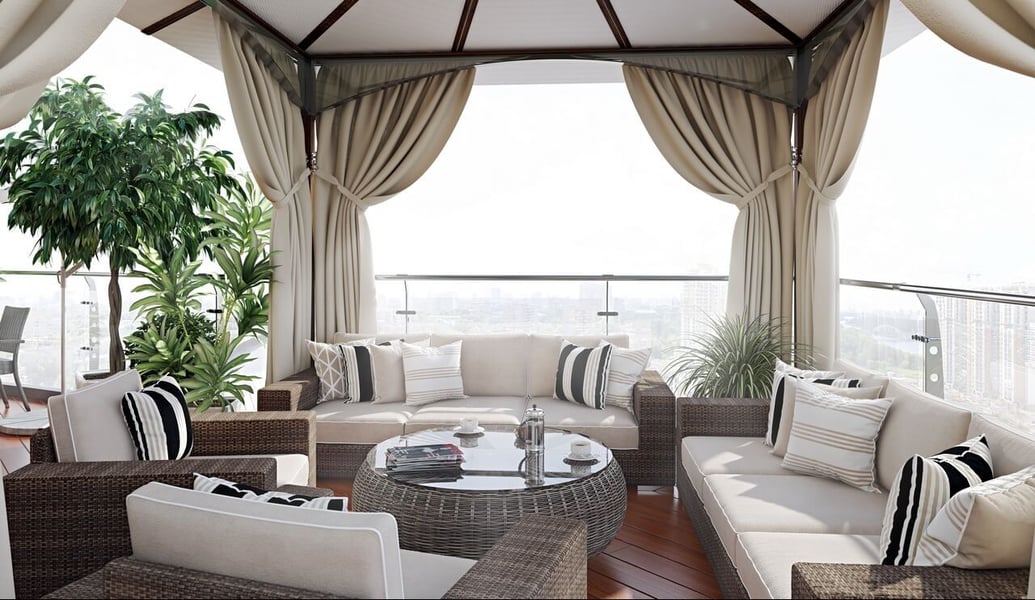
- Rope weave (HDPE or polyester) — common in contemporary outdoor seating, this material has a very specific cord profile and spacing. The geometry needs to be modeled accurately, and the texture must capture the slight surface sheen of the synthetic fiber.
For brands with complex outdoor material libraries, providing physical swatches or high-resolution macro photographs of each fabric and finish is essential. See our guide on what files you need to start a rendering project for how to prepare material references.
Realistic Outdoor Lighting: HDRI, Sun Angle, and Shadow Quality
Natural light is the most complex lighting scenario in rendering. A convincing outdoor scene depends on three interconnected elements working together: the HDRI environment (which provides the ambient sky light and reflections), the directional sun light (which creates the main shadow-casting light source), and the time of day (which determines the color temperature and angle of everything).
High-quality outdoor renders use HDRI environments that were captured in real locations — not procedurally generated sky domes. A real HDRI captures the color variation of an actual sky, the subtle reflections from nearby surfaces, and the atmospheric haze that makes distant objects read correctly. A procedural sky often looks slightly artificial because it lacks this complexity.
Shadow quality is where many outdoor renders fail. Hard midday shadows create strong contrast that can obscure important product details. A slightly lower sun angle — late morning or mid-afternoon — produces longer, softer shadows that wrap around the product more gently and are more flattering for most outdoor furniture categories. For cushions and soft goods especially, this lighting approach reveals texture more clearly.
Environmental Settings: Choosing the Right Outdoor Scene
The setting of an outdoor render communicates the aspirational lifestyle your product belongs to. A rustic wooden dining table on a garden terrace with stone pavers speaks to a very different buyer than the same table on a rooftop deck in a contemporary urban apartment building. Choosing the right environment is a marketing decision, not just a creative one.
The most commonly requested outdoor settings in furniture CGI are:
- Poolside / pool deck — works especially well for lounge chairs, daybeds, and side tables. The reflective pool surface adds visual richness and suggests a luxury lifestyle.
- Garden terrace / patio — the most versatile setting. Works for dining sets, lounge groups, and accent pieces. Natural greenery softens the scene and works across a wide range of furniture styles.
- Rooftop deck — strong choice for contemporary and urban brand positioning. The city or skyline backdrop makes the product feel aspirational and modern.
- Beach house deck — works well for coastal brands, rattan and teak products, and anything with a relaxed, natural aesthetic.
- Balcony / small-space outdoor — relevant for apartment dwellers who are a significant segment of outdoor furniture buyers. Smaller scenes with space-efficient layouts resonate strongly.
Our lifestyle rendering service includes environment selection consultation. We help you match the scene to your brand positioning before starting the build — not after three revision rounds.
Seasonal Content: One Product, Multiple Campaigns
One of the most underutilized strategies in outdoor furniture marketing is seasonal scene variants. The same 3D model can be placed in a bright summer poolside scene and a warm amber fall terrace scene, giving you campaign-ready assets for both the spring/summer selling season and the early fall closeout period — with no additional photography cost. This model-reuse logic is the core of a scalable CGI strategy — our article on scaling a furniture brand with 3D rendering explains how the economics improve significantly with each reuse of the same asset.
Seasonal variants are also useful for showing the same product in different climate zones. A brand selling nationally benefits from showing its outdoor dining set in both a sun-drenched California patio setting and a more sheltered Pacific Northwest deck with overcast natural light. These variations cost a fraction of new photography while extending the reach of your visual content significantly.
Weathering and Finish Effects: Pristine vs. Lived-In
Most product renders show furniture in a pristine, just-unboxed state — and that is appropriate for most eCommerce listings. But for catalog imagery, brand storytelling, and editorial content, a slightly lived-in look can be more compelling. A teak bench with slightly uneven weathering, a cushion with a natural sink from use, or a table with the faint ring of a water glass all read as more authentic and aspirational than a sterile showroom-perfect render.
Whether to show pristine or lived-in depends on the brand positioning and content channel. Pristine is correct for main product listing images on Amazon, Wayfair, or any marketplace where buyers are evaluating the product condition. Lived-in is more appropriate for Instagram campaigns, brand look books, and editorial placements where lifestyle storytelling is the goal.
Outdoor furniture accounts for 30%+ of seasonal eCommerce furniture sales. Having lifestyle renders in at least 2 different environment settings — poolside and terrace, for example — significantly boosts seasonal conversion by giving buyers multiple visual contexts to envision the product in their own outdoor space.
Using Outdoor Renders for Amazon, Wayfair, and Catalog
Platform requirements vary, and outdoor furniture CGI needs to be planned with the final destination in mind. For Amazon, the main product image must be on a pure white background — the outdoor lifestyle render goes in slots 2 through 9. For Wayfair, lifestyle images are increasingly being used as the hero image in category browse, which makes the quality of your outdoor scene critical for click-through rates.
For print catalogs, outdoor renders need to be delivered at minimum 300 DPI at final print size — typically meaning a source file of at least 4,000 pixels on the short side for a full-page spread. CGI has a significant advantage here over photography: you can render at any resolution without additional cost, whereas reshooting at higher resolution for print requires a full new production day.
To ensure a smooth outdoor rendering project, the quality of what you send the studio matters as much as what they produce — read our guide on what files you need to start a rendering project to prepare the material and dimension references outdoor furniture requires. For larger projects spanning multiple outdoor SKUs, it also helps to prepare a thorough brief — see our article on how to brief a 3D rendering studio. To see how CGI stacks up against traditional photography for outdoor furniture specifically, read our comparison of lifestyle 3D rendering for furniture and how these images perform across channels.
Ready to Get Your Furniture CGI Quote?
Send us your product specs and we'll prepare a personalized rendering quote within 24 hours.
Request a Free Quote →