Why Furniture Has the Highest Return Rate in eCommerce
Across all product categories sold online in the US, furniture consistently ranks at the top for return rates. Industry estimates place furniture returns between 25% and 35% of all online purchases — significantly higher than apparel, electronics, or home goods. The core driver is simple: furniture is large, lives in a specific space, and photographs deceptively.
A sofa that looks compact in a product photo may overwhelm a small apartment living room. A dining table photographed in a bright studio reads as light oak, but arrives looking much darker under the buyer's home lighting. A sectional configured one way in a listing doesn't fit around a buyer's load-bearing column. These aren't quality failures — they're information failures, and they're expensive for both the retailer and the customer.
Return logistics for furniture are among the costliest in retail. White-glove pickup, repackaging, refurbishment if needed, and restocking all eat into margins at a category where shipping alone can run $150–$400 per order. Reducing the return rate by even a few percentage points translates directly into significant profit improvement at scale.
What AR Product Visualization Is — and How It Works for Furniture
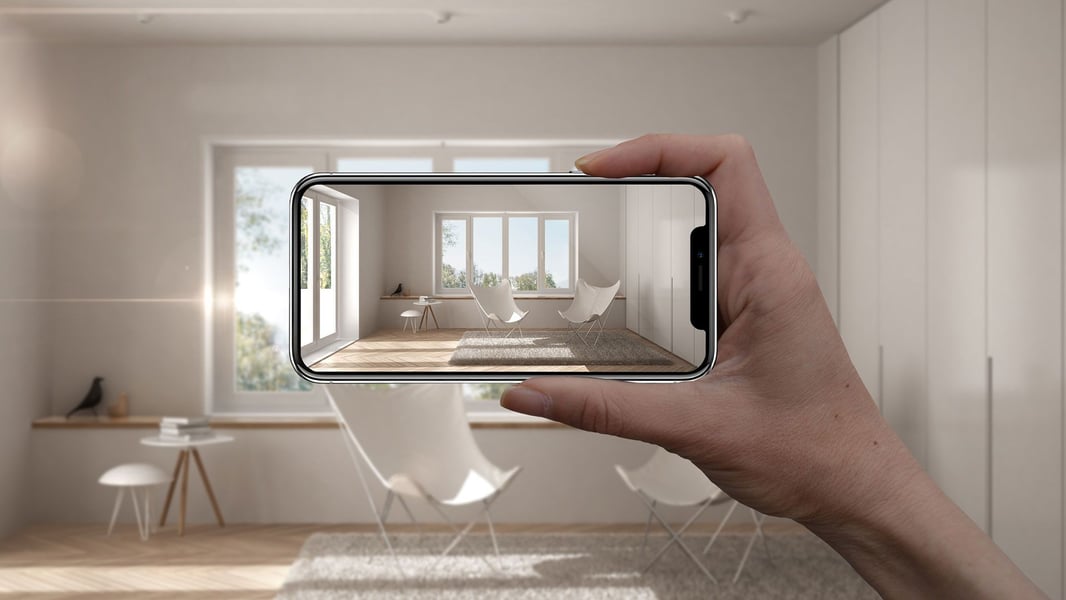
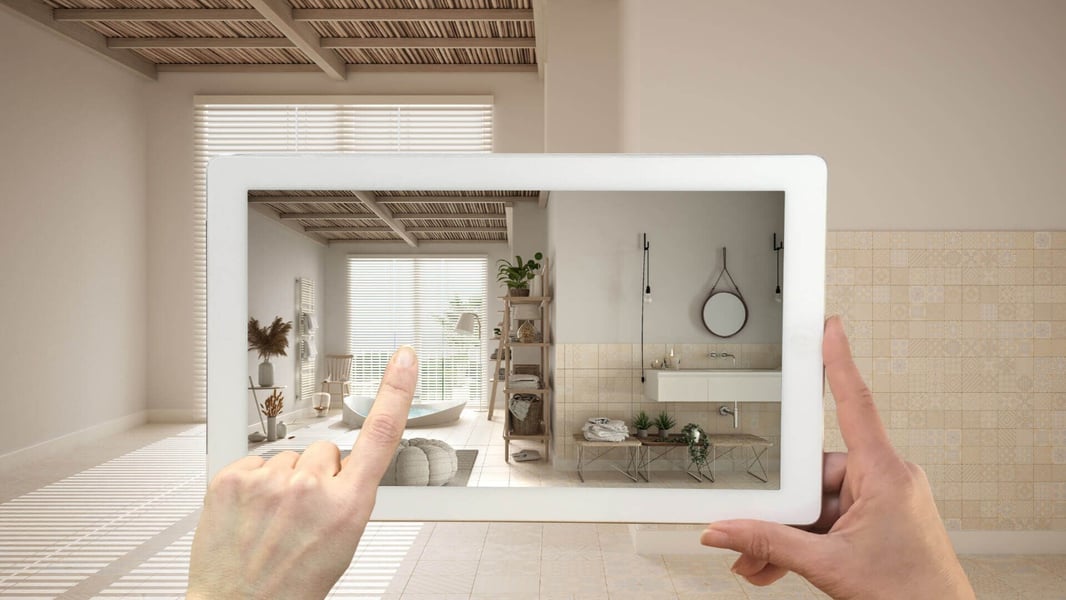
Augmented reality (AR) product visualization allows a shopper's smartphone or tablet camera to overlay a digital 3D model of a product into their real environment in real time. The shopper points their device at the floor or a wall, places the virtual furniture item, and can walk around it, view it from different angles, and judge whether it fits the space.
For furniture, this addresses the three most common return triggers simultaneously: size (the AR model is true-to-scale), color and finish (the 3D model renders materials accurately under the room's actual lighting conditions), and spatial fit (the shopper can see whether the piece works with existing furniture and the room's layout).
The technology runs natively on modern iOS (via ARKit) and Android (via ARCore) devices — no app download required. Shoppers encounter a "View in Your Room" or "View in AR" button on the product page, tap it, and within seconds are placing a photorealistic model of the product in their home.
Impact on Return Rates: What the Data Shows
The measurable impact of AR on furniture return rates is well-documented across the industry. AR product visualization consistently reduces furniture return rates by 25–40% among shoppers who use the feature before purchasing. The mechanism is straightforward: a shopper who has already placed the item in their room and confirmed it fits has removed most of the uncertainty that drives post-delivery disappointment.
Furniture has a 30%+ return rate in US eCommerce — AR visualization consistently reduces this by helping customers confirm size, color, and fit before purchase. For a retailer processing 500 furniture orders per month, even a 10-point reduction in return rate removes 50 costly reverse-logistics events monthly.
Beyond returns, AR also improves conversion. Shoppers who engage with AR features spend more time on product pages, show higher add-to-cart rates, and have lower cart abandonment compared to shoppers who only view static images. The confidence generated by placing an item in their actual space reduces hesitation at the purchase decision point.
How to Get AR-Ready 3D Models: Process and File Formats
AR-ready 3D models for furniture require a specific production pipeline. The process starts with a high-accuracy 3D model of the product — built to the product's exact dimensions, with properly mapped materials and textures. This is the same foundational asset used to create lifestyle renders, silo images, and 360° spin sets, which is why brands that invest in 3D modeling early see compounding returns across all their visual assets.
From the base 3D model, two primary AR formats are produced:
- USDZ — Apple's format for iOS and Safari. Required for AR Quick Look on iPhones and iPads. Supports materials, textures, and animations.
- GLB — the binary format of glTF, used on Android devices via Scene Viewer, and also the standard for web-based AR (WebXR) and platforms like Google Search AR.
File size matters for AR: models need to load quickly on mobile connections. A well-optimized furniture AR model targets 5–15 MB for the GLB and a similar range for USDZ. This means the 3D model must be optimized — polygon counts reduced for real-time rendering, textures compressed without visible quality loss, and unnecessary geometry removed. A studio experienced in AR delivery handles this as part of the production process. You can review the types of AR models we produce to understand what the output looks like across different furniture categories.
Platform Integration: Amazon, Shopify, and Wayfair AR Programs
The three most significant sales channels for US furniture brands each have established AR programs that accept 3D models:
Amazon 3D/AR: Amazon's View in 3D and View in Your Room features are available to sellers who submit qualifying 3D models through the Amazon 3D program. Amazon accepts GLB files and applies its own rendering engine. Products with 3D models often receive prominent placement in AR-enabled search results.
Shopify AR: Shopify natively supports AR through its 3D model media type. Upload a GLB and a USDZ file to a product, and Shopify automatically displays an AR button on iOS and Android browsers without any additional app or plugin. This is one of the most accessible implementations available to independent retailers.
Wayfair: Wayfair has invested heavily in its own 3D and AR capabilities. Suppliers who provide 3D models gain access to Wayfair's AR visualization feature, which is prominently surfaced on product pages for mobile users. Wayfair publishes technical specifications for model submission through its supplier portal.
Cost and ROI of AR for Furniture Retailers
The cost of producing AR-ready 3D models varies by complexity. A straightforward upholstered chair or accent table typically costs less to model than a sectional with multiple configuration options or a storage unit with detailed hardware. As a general benchmark, a production-quality AR model (including GLB and USDZ outputs, optimized for mobile) runs in a comparable range to a full lifestyle render set for the same product.
The ROI calculation is relatively direct. If the average furniture return costs $200–$350 in reverse logistics, refurbishment, and restocking, and AR reduces your return rate by 25%, a brand processing 200 orders per month at a 30% return rate (60 returns) would reduce to roughly 45 returns — saving $3,000–$5,250 per month. A catalog of 50 AR-ready models, amortized over a year, typically pays for itself within the first 2–3 months of deployment at moderate order volumes.
Additionally, 3D models are permanent digital assets. The same model that powers AR on launch day generates lifestyle renders for next year's catalog, variant images when you add a new fabric, and 360° spins for wholesale buyers — without any re-modeling cost.
Ready to Get Your Furniture CGI Quote?
Send us your product specs and we'll prepare a personalized rendering quote within 24 hours.
Request a Free Quote →Getting Started: What You Need to Provide
To produce AR-ready 3D models for your furniture catalog, a CGI studio needs accurate product reference materials. The more detail you provide, the more accurate and faster the production:
- Exact dimensions (width, depth, height, and seat height for seating)
- Material and finish specifications (fabric name/code, wood species and stain, metal finish)
- Multiple reference photos from different angles, including leg and hardware close-ups
- Any existing technical drawings or CAD files (dramatically speeds up modeling)
- Confirmation of which variants (colors, configurations) need AR models
If you're evaluating AR models for the first time, starting with your 5–10 bestselling SKUs is a practical approach. These are the products where return savings and conversion improvement will be most visible, and they give your team a clear benchmark for the ROI before expanding to the full catalog. Before you begin, review what product files and references you need to start a 3D rendering project — the same inputs are needed for AR model production. For brands thinking about how AR fits into a broader CGI strategy across a growing catalog, our guide on scaling a furniture brand with 3D rendering explains how these assets compound in value over time. For guidance on putting together a clear project brief, see our article on how to brief a 3D rendering studio. Contact us to discuss your catalog size and get a production timeline estimate.